

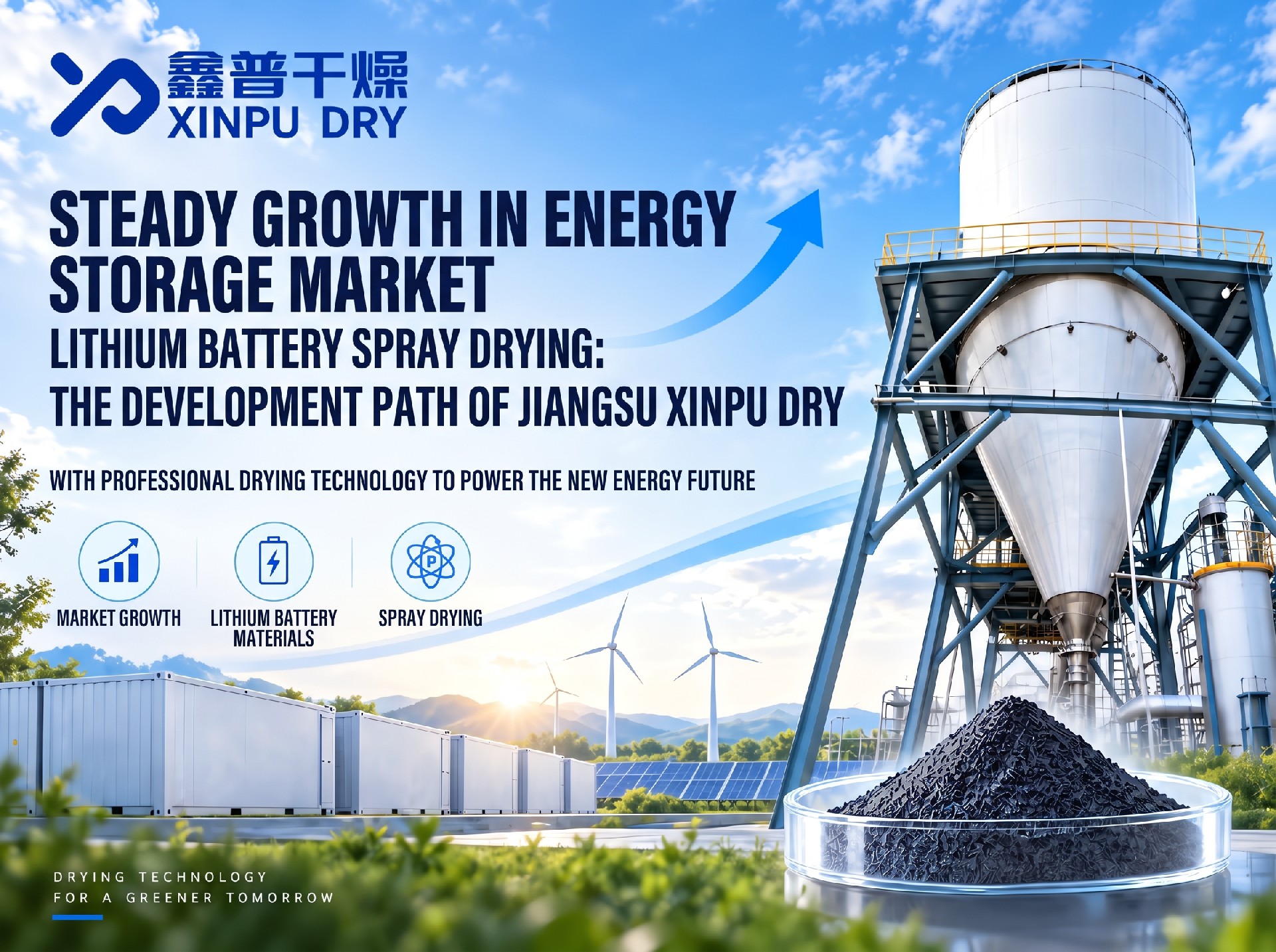
Energy Storage Industry Enters a Golden Era of Development
A recently released white paper on energy storage by TÜV Rheinland shows that China occupies an important position in the global energy storage market. Last year, China contributed approximately half of the world's newly installed energy storage capacity, with the domestic new-type energy storage installed scale approaching 150 GW. According to forecasts, by 2030, China's new-type energy storage installed capacity will conservatively reach 371 GW.
Driven by this wave of energy storage development, all links in the lithium battery manufacturing industry chain are embracing new development opportunities. Among them, spray drying, as a key process link in lithium battery material production, directly affects the particle size distribution, particle sphericity, and batch-to-batch consistency of cathode materials, making it a crucial factor determining battery performance.
The Core Value of Spray Drying Technology
In the preparation process of lithium battery cathode materials, spray drying is responsible for converting precursor solutions into powder particles with specific particle sizes and morphologies. The level of process control at this stage is directly related to the material's tap density, specific surface area, and electrochemical performance.
Specifically, spray drying requires balancing multiple process parameters: the atomization method determines the initial size and distribution range of droplets; inlet air temperature and air volume affect the drying rate and particle morphology; and feed speed is directly linked to production capacity. Fluctuations in any single parameter can cause quality differences between batches, which in turn affects the consistency performance of downstream batteries.
As energy storage batteries continue to evolve toward larger capacity and higher safety, battery enterprises are imposing stricter control standards on indicators such as particle size distribution, tap density, and moisture content of cathode materials. This places higher demands on the process precision and operational stability of spray drying equipment.
Jiangsu Xinpu Drying: Building Competitive Barriers Through Deep Technical Expertise
Jiangsu Xinpu Drying Equipment Co., Ltd. has been deeply engaged in the field of drying technology for many years. Targeting the process characteristics of lithium battery materials, the company has developed exclusive spray drying equipment for lithium battery materials. This equipment addresses the main pain points in lithium battery cathode material production with targeted optimizations in atomization control, hot air distribution, automation integration, and corrosion-resistant design.
Key equipment features:
1. Controllable and adjustable atomization particle size: With a wide D50 adjustment range, it can adapt to different material systems such as lithium iron phosphate and ternary materials, meeting diverse particle size requirements.
2. Uniform hot air distribution: Delivering high drying efficiency — according to test data, energy consumption is reduced by more than 15% compared with traditional equipment, helping to lower production costs.
3. High degree of automation: Supports DCS system integration and can be connected to the continuous production needs of lithium battery production lines, reducing manual intervention and improving batch consistency.
4. Corrosion-resistant design of key components: Made of corrosion-resistant materials, it can adapt to high-wear working conditions such as lithium iron phosphate, extending equipment service life and reducing maintenance frequency.
From Lithium to Sodium: Forward-Looking Layout for Emerging Technology Routes
The rapid growth of the energy storage industry is driving technological upgrading in the upstream equipment manufacturing sector. As a key link in material production, the technological progress of spray drying equipment is closely tied to the development pace of the lithium battery and sodium battery industries.
Notably, in addition to supporting the capacity expansion needs of the energy storage battery industry, Xinpu Drying's spray drying equipment has already carried out forward-looking technology reserve work for emerging technology routes such as sodium-ion batteries. The preparation process of sodium battery cathode materials differs from that of lithium batteries, posing new challenges for the adaptability of the drying process. By adjusting the atomization system and temperature control strategy, Xinpu Drying provides process support for the mass production of sodium battery materials.
Industry Outlook
From a global perspective, the expansion trend of the energy storage industry is established, and the technological upgrading of upstream materials and equipment manufacturing is accelerating. Spray drying, as a critical bridge connecting material formulation with finished powder quality, directly bears on the large-scale mass production capacity of energy storage batteries.
Facing the continuous expansion of the energy storage market, Jiangsu Xinpu Drying Equipment Co., Ltd. will continue to invest R&D efforts in drying process optimization, equipment intelligence, and material adaptability, providing reliable equipment support for new energy material manufacturing. Amid the energy storage boom, equipment enterprises rooted in technical沉淀 are ushering in their own breakthrough moment.
Translation note: Technical terms such as "D50" (median particle diameter), "tap density" (振实密度), "specific surface area" (比表面积), and "DCS system" (Distributed Control System) have been translated using standard industry terminology.